
As we hit the reset button for the year, you can help turn 2024 into a journey of academic progress and success. There’s no better time than now to help your child establish great study habits for the rest of the school year.
In this blog, I’m sharing three study habits you can start working on with your child this week.
How can parents help kids get more organized in the New Year?
The first step is to establish habits. Research on habit formation shows that when it comes to changing behavior, it’s less about willpower and more about setting up routines.
For example, let’s say you want your child to be more organized this year. Try something called a “Clean Sweep.” A Clean Sweep is a 20-minute block of time to get organized for the coming week. For kids it might include cleaning out their backpack or looking through their school portal.
The key is to have this type of activity tied to something already part of your weekly routine, such as after a Sunday dinner. And remember, you have to be part of the Clean Sweep too, and that’s because kids are more likely to follow through when someone else helps to keep them accountable. While your child is doing a Clean Sweep, you can use the time to organize your junk drawer or confirm your appointments for the upcoming week.
When is the best time to study, especially those who are tightly scheduled and go straight from school to sports or another activity?
Many kids don’t know how to take advantage of small chunks of time. In fact, research shows that studying in small chunks as opposed to long stretches is more beneficial to remembering.
For example, if there’s a science test on Friday, your child has two choices for studying:
- Study the night before for an hour, which is what most kids will do.
- Take that same amount of time and break it up into small increments – 20 minutes on Tuesday, 20 on Wednesday, and 20 minutes on Thursday.
This second choice is what translates into a better grade because you’re repeating the information and putting it into long-term memory by sleeping on it.
So, when kids have these small gaps of time between school and activities, this is really where their opportunity lies to develop a healthy study habit.
My child has a lot of upcoming tests and projects. How can I help him prepare to get it all done on time?

This is the time of year when teachers tend to pile on end-of-quarter homework and projects and these projects can account for a big part of the report card grade.
So first, you need to find out what’s big that is due. Is there a large assignment such as a book report or research paper? Sit down with your child to make sure she has a game plan – if not, work with her to come up with one.
So often, kids procrastinate because they’re overwhelmed and underprepared, not because they simply don’t want to do the work. They need a parent or another adult to help them backwards plan. This is where you or our executive function coaches come in. Backwards planning is when you identify the big goal and date due and then all the little steps needed to get there.
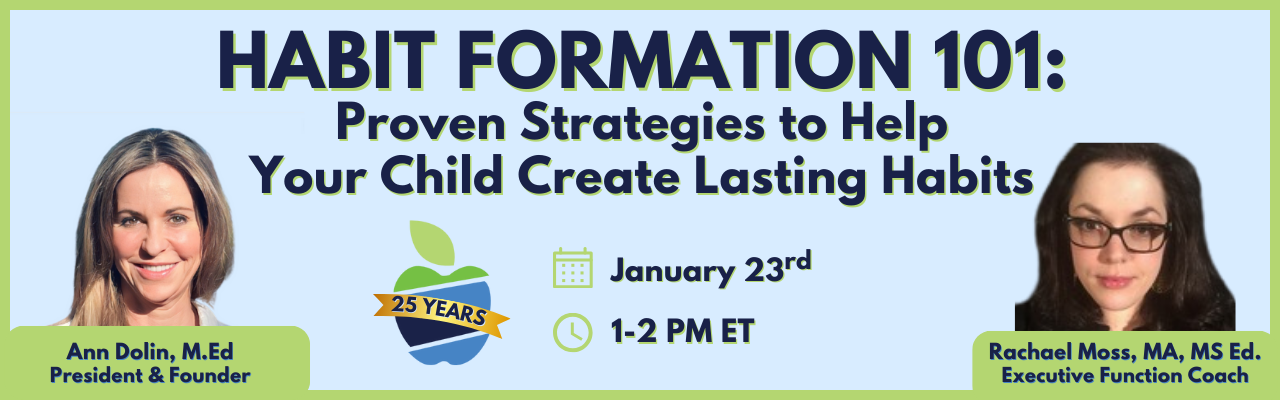
For a deep dive on student habit formation in the New Year, we invite you to register for our upcoming webinar-
Habit Formation 101: Proven Strategies to Help Your Child Create Lasting Habits